



In the late Spring of 2024, I gave a talk on Christian masculinity at Pusey House, an anglo-catholic chapel and study centre in Oxford, England. Pusey House is located on St Giles Street, slightly north of the Oxford city centre and just a few doors down from The Eagle and Child, the pub famous for being frequented by “Inklings” like C.S. Lewis and J.R.R. Tolkien. (By the way, Pusey is, without question, the best place to participate in the traditional Anglican liturgy of morning prayer in Oxford if you ever have opportunity to visit.)
I honestly don’t remember a whole lot about what I said in the talk itself, but I remember the first question of the Q&A portion clearly.
A young man in his mid-20s raised his hand after I opened up the floor. Once he spoke, I realized he was American, like myself, visiting Oxford as a postgrad student. This was his comment/question:
So, I don’t know any Greek. But I do know one word, and that’s the word for ‘meek’ and I’m not even sure the right way to pronounce it. I think it’s praus [he mispronounced it], and I’ve heard it means: like a warhorse – as in powerful, but also controlled. How does that figure into the New Testament and what you’re talking about with a Christian vision for masculinity?
This was not the first time I had heard this word defined this way. In fact, this is a remarkably common talking point among American evangelicals on the concept of meekness, particularly when discussing Jesus’ teaching in the Sermon on the Mount, “Blessed are the meek [πραεῖς, praeis]” (Matt 5:5), or his self-description, “I am gentle [πραΰς, praüs] and lowly of heart” (Matt 11:29).
This interpretation of the term also regularly shows up in conversations about biblical manhood™ and what it looks like to imitate Jesus in his masculinity. The 'warhorse' definition of praüs is widely used in preaching and popular biblical interpretation. If you’re reading this article, there’s a good chance you’ve heard some version of this before.
As a long-time reader of ancient Greek, I have suspected for a while that something was off about this interpretation. But two months ago I got fed up with how often I was seeing this claim made with both confidence and a complete lack of ancient linguistic evidence.
So, I decided to get to the bottom of it myself.
This was my question: For ancient Greek speakers/readers, would the word praos/praüs (πρᾶος/πραΰς)1 have brought to mind warhorses?
To investigate this thoroughly, I undertook a project to search and study all ancient uses of praüs that exist in the historical record.2 There are about 350 instances in which the term is used in Greek literature that predates the New Testament, and (to my knowledge) no one has ever combed through each of them to answer this question. After generating the dataset of hits, I’ve spent recent weeks looking up every single reference to determine how the word was being used in context.
Having done that, I am now very confident in claiming that my hunch was right. The 'warhorse’ definition is historically misleading, linguistically incorrect, and (probably) completely made up.
I’ll show some of the receipts below. But first, some background.
Blogs and Bad Linguistics
The 'power under control' and 'like a warhorse' definitions of praüs have been around for at least a couple decades. As best I can tell, this interpretation was posited and popularized, not by Greek language or biblical scholars, but by Christian bloggers in the early 2000s. Marg Mowczko narrates some of this history and cites a few examples of the argument in an excellent article published in 2020.3 Mowczko notes several examples in her piece (most of which have since been scrubbed from the internet). Here’s another still live example of the argument/claim:
Jesus said, in what’s known as the beatitudes, “Blessed are the meek for they shall inherit the earth” (Matthew 5:5). When we think of meek, synonyms like weak, timid, shy, humble, resigned, gentle, and passive spring to mind.
…
It wasn’t until I heard the passage explained in the original Greek that it made more sense. The English word Meek is often translated from the old Norse meaning of gentle or mild. However, the work [sic] meek from the original Greek translation is praus and can mean strength under the control of God’s power. It was often used regarding the training of wild horses. For a horse to be “meeked,” it meant they were obedient under the command of their rider. These animals wouldn’t have been considered timid or gentle. They were strength humbly yielded to their master.4
There’s also an oft-repeated anecdote (again, Mowczko cites a few examples) about military commanders going up “into the mountains” and bringing horses down to train them for use in battle. It’s admittedly a cool and interesting image, and I suspect it preaches very well as a background story for understanding the word meek in the sense of tame in English.
The trouble is, as Mowczko points out, these blogs never cite a single Greek source in support of the claim that “praüs comes from ancient military training.” The story about the mountains in particular seems to be completely made up (perhaps by an imaginative and narrative-license-taking preacher in the late 1900s). But this is worse than a fanciful historical anecdote. It’s also historically unlikely. Wild horses, while sometimes found in the mountains, far more often prefer open plains and grasslands. And here’s the kicker. In classicist J.K. Anderson’s 1963 book Ancient Greek Horsemanship, he opens his very first chapter with the foundational premise: “Wild horses were unknown in the countries around the Mediterranean.”5
All the evidence suggests that the going up into the mountains and “meeking” the wild horses imagery is an utter fabrication. For decades, people have been simply asserting (and repeating what others have asserted) that the Greek praüs “comes from” this practice despite having no specific source, knowledge of Greek themselves, or evidence from ancient history.
More recently, the idea that praüs really means 'power under control' (and not 'gentle'/'meek') has had an online resurgence. My sense is that much of that resurgence is thanks to Jordan Peterson. He discussed meekness in one of his (very popular) Biblical Lectures in 2017.6 In the lecture, Peterson says he had learned (after studying “the roots in ancient Greek and Hebrew”) that the translation “blessed are the meek” for Matt 5:5 was “wrong.” Instead, Peterson claims, it means, “Those who have swords and know how to use them but still keep them sheathed shall inherit the earth.”7
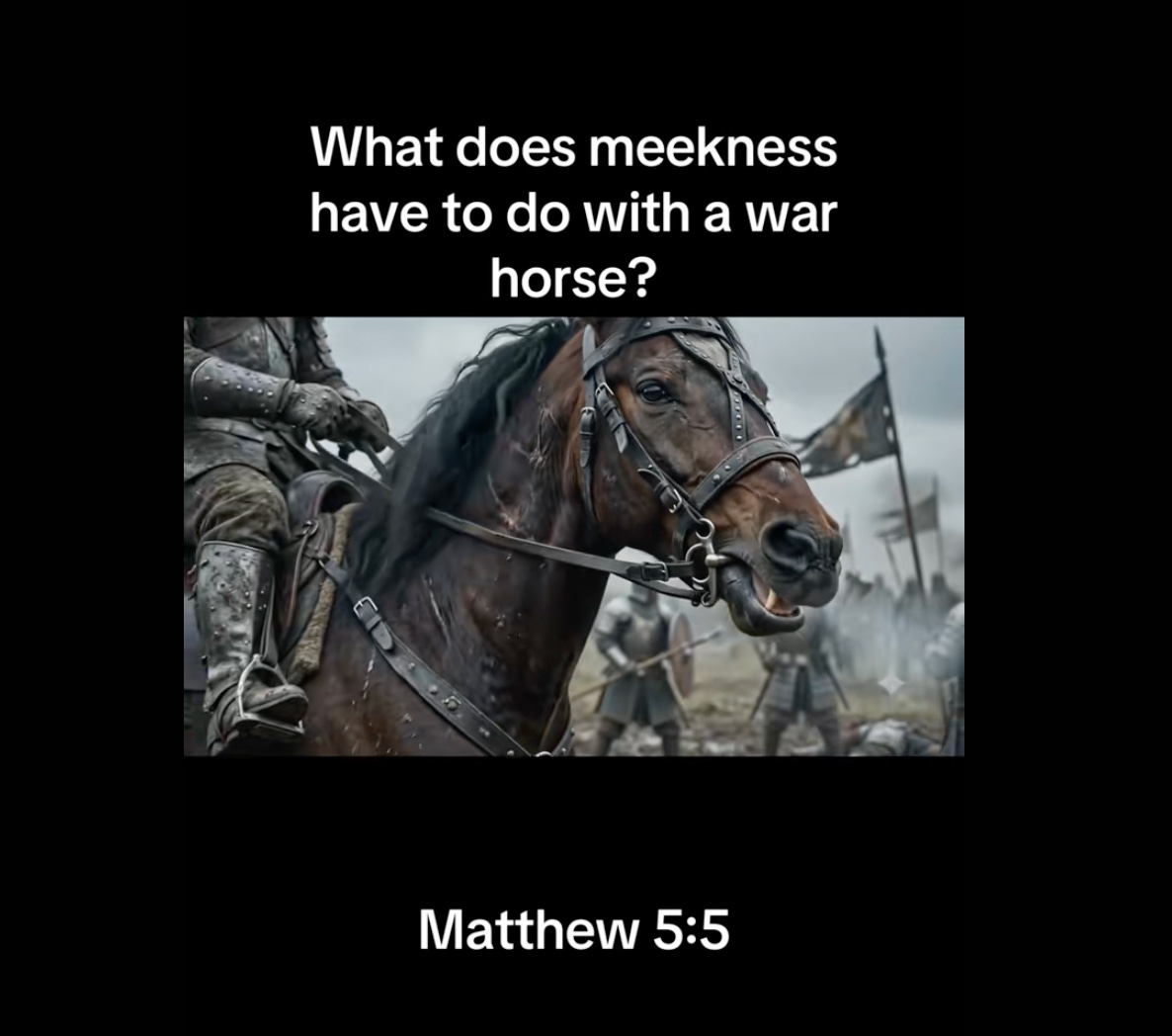
Fast forward to today and this claim about meekness and the Greek word praüs is kind of everywhere. From sermons, to podcasts, to YouTube videos, to AI-generated YouTube Slop. And if the idea that biblical meekness should remind you of a warhorse hasn’t quite made it to the mainstream yet, it’s about to. This “definition” serves as the title and framing device of a soon-to-be bestselling book by Christian apologist and influencer Ryan Miller, who boasts 1.8 million followers on Instagram and 1.5 million on TikTok. Here’s the cover:

Now, I haven’t read this book, nor am I very familiar with Miller’s platform/ministry. My guess is that there will be all manner of good and godly advice in here for his followers and fans. But that advice and insight, such as it is, will be couched and framed in a misrepresentation of a biblical concept and of the teaching of Jesus in particular.
In his promotional interviews and past podcasts, Miller parrots the false warhorse definition we’ve been discussing, as well as the “going up into the mountains” anecdote. But the truth is (as I will show below) that the word praüs has (almost) nothing to do with horses. And Jesus’ teaching in Matthew 5 has literally nothing to do with horses. My believing-the-best read of Miller is that he has also been led astray by these blogs.8 Still, good and godly advice ought not be abetted by fabrications about the Bible and biblical language – even if those fabrications preach well and are good for book marketing.
Perhaps more importantly, we do not serve Jesus or the gospel well by misrepresenting his teaching to smooth over its offense to our own cultural sensibilities (as these bloggers and authors regularly do with their “meek not weak” framing). This isn’t an article about Miller or Meek As a Mustang, but seeing the pre-release marketing for the book did motivate me to do the research for this article, so I thought this was worthwhile context to note.
The Receipts
(This section will get a little technical. If you’re not into that or just want to take my word for it, feel free to skip to the summary and conclusion. Greek nerds, enjoy.)
Okay, let’s transition to the actual linguistic data. Again, this is from a search of all extant (i.e. surviving in the historical record) uses of the word praos/praüs in Greek literature up through the New Testament. The dataset includes almost 1000 years of usage, and, importantly, language can evolve quite a bit over a stretch of time like that. Greek in particular evolved significantly during this span (some will be familiar with the distinction between Attic Greek v. Koine/Hellenistic Greek). That being said, my sense is that the usage of praos/praüs is relatively stable, i.e. it doesn’t change all that much over the centuries.
After studying this data, I found there are several buckets of usage or “meanings” for the word. They are:
1 – 'Gentle' as a description of temperament, disposition, or virtue.
This is far and away the most common usage for praos/praüs. In cases such as these, the word is used to describe someone’s character, i.e. that they are a 'gentle' person by disposition or as a matter of their cultivated virtue. For example:
He that knows the temperate life will set it down as gentle [πρᾶον] in all respects, affording mild pleasures and mild pains, moderate appetites devoid of frenzy.
(Plato, Laws, 733e.7)
Some of the most well-known and oft-cited examples of this use come in Aristotle. For instance:
We count anger the contrary of gentleness [πραότητι] and the passionate man the contrary of the gentle [πράῳ]; yet there is also in the direction of being gentle and placable and not being angry when struck, but men of that sort are few, and everyone is more prone to the other extreme.
(Aristotle, Eudemian Ethics, 2.5 [1222b])
Or:
For “gentle” really denotes a calm temper, not led by emotion but only becoming angry in such a manner, for such causes and for such a length of time as principle may ordain; although the quality is thought rather to err on the side of defect, since the gentle-tempered [πρᾶος] man is not prompt to seek redress for injuries, but rather inclined to forgive them.
(Aristotle, Nicomachean Ethics, 4.5 [1125b])
These passages and discussions of praos-ness in Aristotle are pretty fascinating and quintessentially Aristotelean in their ethical framework.9 I can’t get into the ins-and-outs of the argument in detail here, but suffice it to say that these include easily the most detailed ancient discussion of what the virtue of gentleness is.10
2 – 'Gentle' as a description of mood or behavior.
This second category is closely related to the first. But rather than describing a general disposition or character, it is simply describing someone’s demeanor or behavior at a specific time. This is when the word is used to say that someone is acting gently, which is different than saying they are a gentle person (use 1). For example:
[A]fter showing himself exceedingly cruel… when [Agathocles] thought that he had securely attached the Sicilians to his rule, he became to all appearances the gentlest and mildest [πρᾳότατος] of men.
(Polybius, Histories, 9.23.3)
In this quote, Polybius is not saying that Agathocles was gentle by temperament; he was the opposite, actually. Rather, he is saying that at certain times and circumstances Agathocles acted gently.
There are also fairly common contrastive uses where someone or something is described as gentle (praos) with friends but harsh with enemies.11
3: 'Gentle' as a description of objects or actions.
Praos/praüs can also be used to describe objects or specific actions as gentle. For example, there are a few times where it describes a shape, like a gentle curve. It is also commonly used to describe a gentle/soft tone of voice.12
3b – ‘Gentle’ as a description of water or wind.
Very closely related to the previous use, we see many examples of praos/praüs being used to describe gentle flows of water or pleasant breezes.13
4 – 'Gentle'/'mild' as a medical description of illness or remedies.
This is usually to describe something like a mild fever or a mild medicine.14
5 – ‘Gentle’ as a description of rulers, style of rule, or forms of government.
Not infrequently, praos/praüs is used to describe the rule of specific monarchs or forms of government. For example:
If you care to inquire why a man would sooner live under a democracy than under an oligarchy, you will find that the most obvious reason is that in a democracy everything is more easy-going [πρᾳότερα].
(Demosthenes, Against Androtion 51.9)
or:
According to my desire, I have not been obliged to do anything that is insolent or cruel to my subjects by such my power, but have showed myself mild (πρᾶον) and gentle, by taking care of their peace and good order, and have sought how they might enjoy those blessings for all time to come.
(Josephus, Jewish Antiquities 12.149)
6 – ‘Merciful’/’lenient’ as a description of judgments, laws, or punishment.
Occasionally the word can be used in a sense of a merciful judgment or non-harsh sentencing. For example:
The laws of Athens concerning tyrants were mild at those periods.
(Aristotle, Athenian Constitution 16.10)
7 – 'Gentle'/'tame' as a description of animals.
I end with this use not because it’s the least common but because it is obviously the use of praos/praüs that is most relevant for the claim that it brings to mind a strong but tame and obedient warhorse. I’ll give a little more explanation here.
First, very slightly in favor of this view, there is in Xenophon’s Cyropaedia (1.6.34) mention of horses standing “more quietly” [πρᾳοτέρους] together if they also work together. However, there is no mention of warhorses in particular here.
Slightly more relevant are three related uses in Xenophon’s On Horsemanship. The first is:
Care must be taken that the colt is gentle (πρᾶος), tractable, and fond of man when he is sent to the horse-breaker.
(On Horsemanship 2.3.1)
Here’s another:
The horse that is sound in his feet, gentle (πρᾶος) and fairly speedy, has the will and the strength to stand work, and, above all, is obedient, is the horse that will, as a matter of course, give least trouble and greatest measure of safety to this rider in warfare.
(On Horsemanship 3.12.2)
And finally a verbal use:
It should also be known that a horse can be taught to be calm (πραΰνεσθαι) by a chirp with the lips and to be roused by a cluck with the tongue. And if from the first you use with the cluck aids to calm him, and with the chirp aids to rouse him, the horse will learn to rouse himself at the chirp and to calm down at the cluck.
(On Horsemanship 9.10.3)
Now. Let me emphasize something as strongly as I can. These are literally the only four times in all of recorded ancient Greek that praos/praüs is used to describe horses.15 These do not describe the horse specifically as “powerful but under control,” although that may be a fair description of a tame horse. Nor are these uses specifically in reference to the horse’s tameness or obedience (as other words are used to describe these concepts in the passages).
However, we do find fairly frequent use of the word praos/praüs to describe other animals. Sometimes it is used to describe the behavior (cf. use 2) of otherwise fierce animals such as lions or wolves.16 But just as often it is used to describe the temperament (cf. use 1) of relatively harmless animals, such as camels, fish, sheep, hares, elephants, and cattle.17 When used to describe the temperament of animals, praos/praüs is clearly meant to imply that these creatures are, by nature, not violent or especially dangerous to humans.
Summary of Lexical Data
To my eye, the seven categories above account for all ancient uses of this word.18 I’ve included a chart below summarizing the data. You can clearly see that virtue/temperament use is far and away the most common. It is also, importantly, the dominant use of the word in the Septuagint (Greek version of the Old Testament) that forms the central literary background for the New Testament authors. (The animal description use of praüs never appears in any Jewish literature written in Greek, as far as I can tell.)
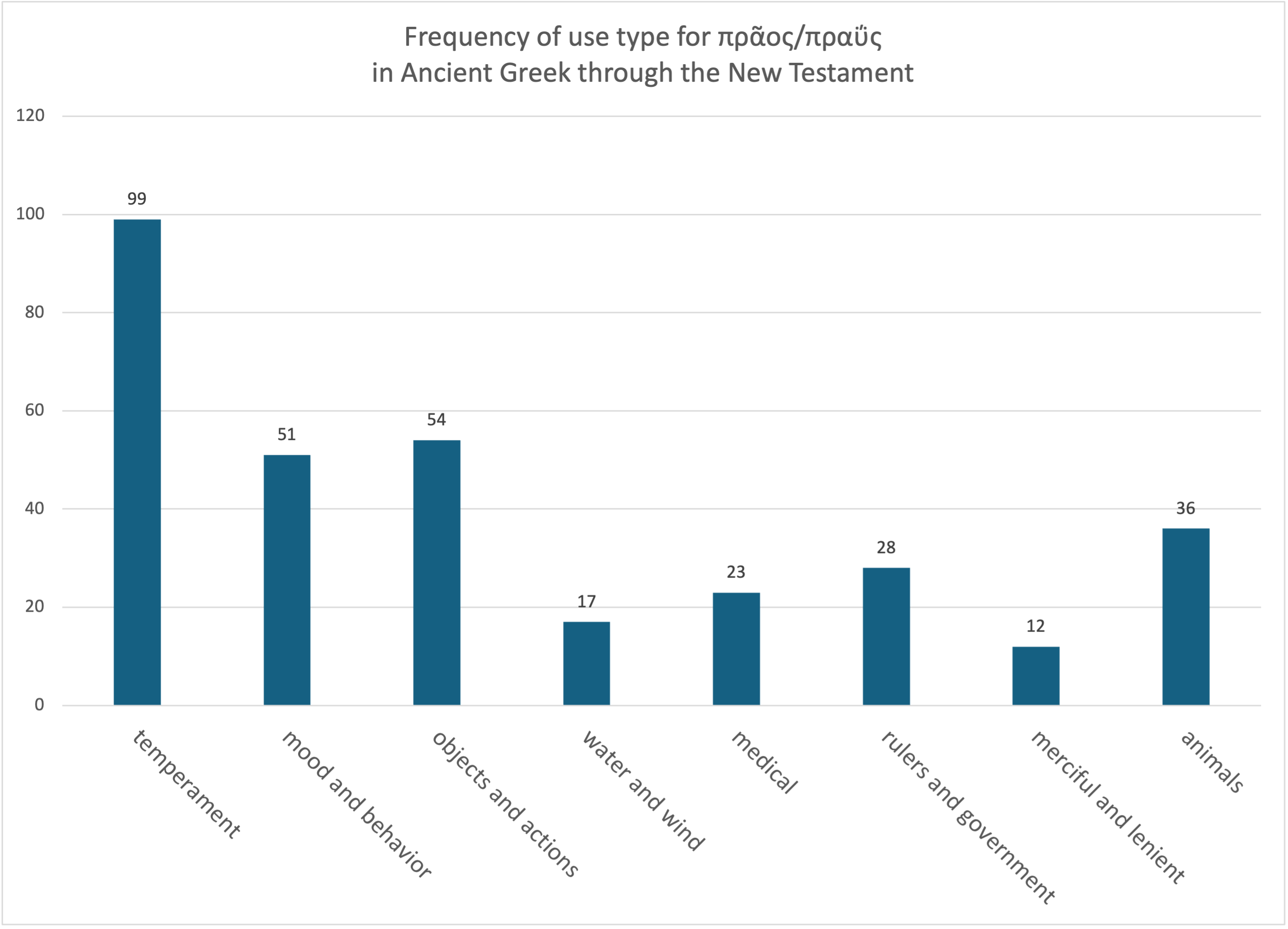
To sum up for the purposes of the main research question though: a horse could conceivably be described as praos, but praos/praüs is definitely not a word regularly used of horses by default, much less a word about horses or horse training.
It is also extremely unlikely that someone hearing/reading the word praüs would have thought of a horse or of warhorses in particular. If they thought of an animal at all, it stands to reason that a lamb or a cow would have come to mind more readily.
What about 'Power under Control'?
Many a preacher or defender of the view I’m arguing against may object that disproving the warhorse idea doesn’t necessarily disprove that the word means something like 'power under control'. Fair enough. While the warhorse association is clearly 99% wrong/false, I would still say that the 'power under control' definition is something like 75% wrong.
I confess, when I set out to do this word study, I was prepared for the warhorse interpretation to be a load of crap. However, as I read through the many uses of this word, I was somewhat surprised to find the “power under control” interpretation slightly more compelling than I expected.
It is true that we see many examples of otherwise fearsome objects, animals, and people being described as praos/praüs. But it’s important to remember that this is akin to an English usage like “gentle giant.” We can describe someone or something powerful as gentle, but that doesn’t mean that the word “gentle” itself means powerful or power under control. At the very least, if anything, we could say that gentleness is an important virtue for the powerful to possess. There are also plenty of surprising uses (e.g. of a lion being tame with its handler), but again these are ironic and contrastive. And they are not the default meaning that the word carries in itself.
To say that, since the word sometimes is used this way it always implies this is what biblical scholars and linguists call an “illegitimate totality transfer,” and it’s one of the most well-known lexical fallacies out there.
Conclusion
I’ll have more to say about New Testament uses of praüs in a future post. But sticking with the subject of this article, I think it’s fair to say that the meek=warhorse lexical legend can be put out to pasture. What is more, people repeating it should be gently (get it?) told that it was made up and irresponsibly repeated for years.
Now, this does not mean that describing something/someone as “meek” necessarily means that thing/person is pathetic or weak. Clearly that’s not true, as there are many examples that show the virtue of gentleness being balanced against strength. But that is different than saying the word carries those connotations in itself.
Importantly, gentleness/meekness/praütes may sometimes appear to be weakness. And the correct response to that perception is not to get all fussy and defensive and say “Hey bro just because I’m meek doesn’t mean I’m weak. I know I’m supposed to be kind and whatever but don’t you dare forget I’m secretly a badass warrior mustang hero.” This reeks of insecurity and a Nietzschean disdain for the actual teachings of Jesus – and the self-consciously radical/paradoxical beatitudes of Matthew 5 in particular. It is an attempt to flatter our masculine egos as Christ-followers – a way to make us feel heroic in spite of the hard teaching that Jesus presents. Our efforts to revise and redefine this word make it seem as if we want the credit towards godliness of claiming “meekness” while retaining the human-directed reputation of being a fearsome warrior.
But it seems to me that, sometimes at least, you can’t have both. Unlike Jordan Peterson, Jesus didn’t teach young men to become self-controlled monsters. He taught them to be gentle. When we collectively panic about Jesus’ teaching that his followers should be “meek,” it says far more about us and our cultural moment than any mistranslation or misrepresentation of a Greek word. In fact, ancient Greek philosophers overwhelmingly viewed praos as a positive character trait and virtue. For them the term needed no apologies, no connections with warhorses, no historical explanations. The pagan philosophers of old knew that gentleness is a virtue. It’s to our shame that so many modern Christians don’t feel the same way.
Πρᾶος/πραΰς doesn’t have some secret definition buried in lost Greek manuscripts, a gnostic insight that only the spiritually initiated can understand. And just because something preaches well doesn’t mean it’s linguistically, historically, or biblically sound.19 Ironically, this word is actually fairly easy to define and translate. It just means 'gentle'.
And, for the record, I actually think meekness is a great character trait to exhort young men towards. Just don’t tell them it means being a secret badass. The gospel of the kingdom is meant to be disruptive to our sensibilities of what power is, of who the world belongs to. Jesus said that it was the gentle, not the powerful, who would inherit the earth. It’s an offensive statement by design. We just need to be willing to let the offense land.
The spelling of the word changes over time in ancient Greek from a final vowel omicron (ο) to a final vowel upsilon (υ). The latter spelling is the one that appears in the New Testament.
I used what’s called a lemma search in TLG (Thesaurus Linguae Graecae), the most complete database of ancient Greek literature in existence. It’s not technically exhaustive (it doesn’t include, for example, many of the papyri scraps used for ancient receipts and record-keeping), but it includes all major works of Greek literature from the ancient world, as well as many very obscure ones. In total, it contains over ten thousand documents.
Marg Mowczko, “The Greek Word ‘Praus’ and Meek Warhorses.”
Lorri Dudley, “Meek as a Lamb or War Horse?”
J.K. Anderson, Ancient Greek Horsemanship, 1.
Jordan Peterson, Biblical Lecture Series IX, “The Call to Abraham.”
This fit well with Peterson’s broader project at the time. He would, for example, regularly say that “harmlessness” was not something to aspire to, and that for young men, the goal should be to “become a monster” and then “learn to control it.”
Although, in at least one podcast episode, he claims to have “looked it up” in a “Greek lexicon” and found the definition “to tame a wild mustang.” This is at worst a lie (i.e. he didn’t actually find that in a lexicon because no existing lexicon claims this); slightly better, ignorance (i.e. Miller doesn’t know what counts as a “lexicon”); and at best a gross misrepresentation of the LSJ entry. That lexicon cites a single instance from Xenophon (Cyropaedia 2.1.29) “of a horse, gentle,” buried under the banner definition “mild, gentle, meek.” It’s also worth noting that online resources like BibleHub, BibleHelps, and Blue Letter Bible include a very mixed bag of claims about this word, some of which seem to be influenced by popular preaching about the idea more than the lexical data I’m putting forward in this article. Although I’m not seeing any references to horses in those places either.
I.e. gentleness is described as a mean between two extremes. Some defenders of the “strength under control” definition will note that this is the most important passage for understanding praüs in the New Testament because it is such a long and thorough discussion of the concept. But this is misguided for a few reasons. First, Aristotle is writing centuries before Jesus’s ministry and that of the early Christians. But, perhaps more importantly, Aristotle himself notes at the beginning of the discussion that there is “no recognized name for the mean in this respect… So we apply the word Gentleness to the mean though it inclines to the side of the defect.” (Nicomachean Ethics, 4.5) In other words, Aristotle grants in his discussion that “gentleness” [πραότης] is not a perfect word for describing this virtue.
For other examples of the temperament use, see: Isocrates, Antidosis 20.5, 300.1; Xenophon, Cyropaedia 1.6.34; Plato, Phaedrus 243c, Laws 11.930a5; Pseudo-Aristotle, Physiognomonics 807b; LXX Numbers 12:3; Dionysius, Art of Rhetoric 3.4.8; Philo, Life of Moses 2.279; Josephus, Jewish War 2.290.
E.g., Xenophon, Agesilaus 11.10.1. For other examples of the mood/behavior use, see: Isocrates, Busiris 6.5; Plato, Republic, 1.354a; Menander, The Grouch 779; Josephus, Jewish War 2.464.
For examples of the object/action use, see: Pseudo-Pythagoras, Golden Verses 6; Xenophon, Symposium 1.10; Aristotle, Problems 1.40; Dionysius, On Literary Composition 23.154; Philo, Life of Moses, 1.331.
For examples of the water and wind use, see: Aristotle, On Breath 5, Problems, 26.26; Apollonius, Argonautica 2.937.
For examples of the medical use, see: Hippocrates, On Crises 26.1, Diseases of Women 12.23; Philo, Allegorical Interpretation of the Laws 1.66.7.
I’d be happy to be corrected on this, but I’m fairly confident making the claim. There is one other use of the word in On Horsemanship that describes a horse rider’s gentle direction of a horse (9.3.4), but this is not a description of the horse itself. There is also a close juxtaposition with a reference to someone (a human) being “well-reined” (Εὐήνιος) and therefore "gentle” (πρᾶος). But the reference is to a human’s temperament, not a horse’s.
Isocrates, Antidosis 211.3; Aristophanes, History of Animals 2.225.
Aesop, Fable 210 3; Xenophon, Anabasis 1.4.9; Pseudo-Aristotle, Physiognomonics 811b28, 813b4; Ctesias, FGrHist 688 F 45g.5; Aristotle, History of Animals, 1.1.
Excluding clear repeats of the same text and a handful of grammatical and non-definitional uses.
Mary Karr’s admittedly lovely and striking poem, “Who the Meek Are Not,” likewise badly misses the point of Jesus’ saying in the beatitudes and the meaning of the Greek term in question.
Such helpful work, brother. I have tired of apologizing for the plain teaching of Jesus, camouflaging the beauty of meekness, and protecting the egos of the supposed bad-asses. We need to face ourselves and ask why we have been avoiding this virtue for so long.
This is a well thought out and written article. Nice work.
Setting the “warhorse” metaphor aside, what images do you think capture gentle/meek well? If I’m teaching on gentleness this fall, what are compelling examples I can point to?
Thanks!